
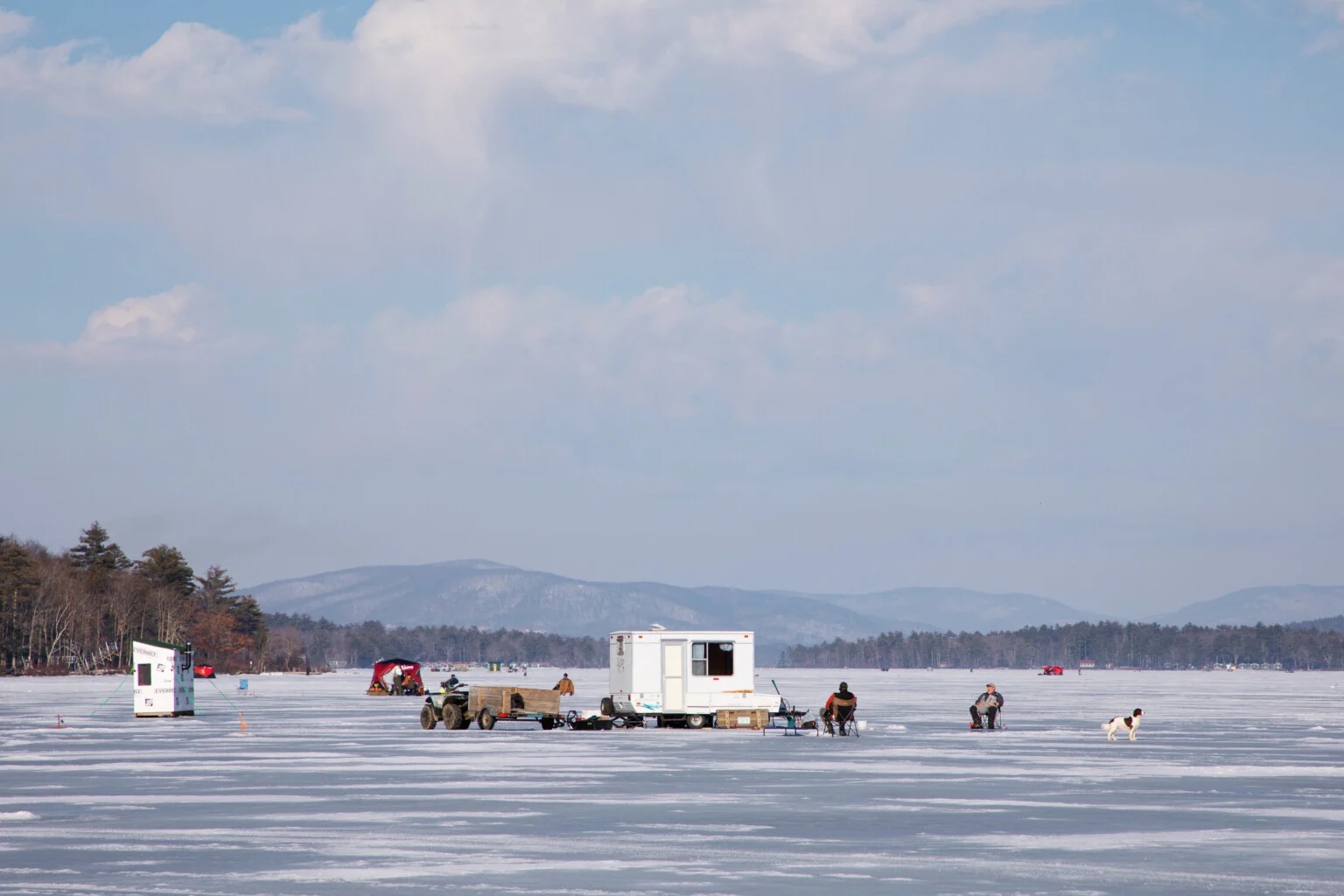
At 22 years old, ice fisherman Vincent Zuccaro may be considered a little young to fully grasp the depth of nostalgia many feel for the good old days of thick, reliable ice on Lake Winnipesaukee. But even he, a plumber from Townsend, Massachusetts, who has spent winters ice fishing since he was 10, notices the changes on the lake. With a family vacation home in Tuftonboro, Zuccaro has participated in the Great Meredith Rotary Fishing Derby for several years, and over time, he's seen a concerning shift in the lake’s ice conditions.
“Back when I started, I remember ice thick enough to take an ATV out on it, and it was still getting thicker as you moved toward the middle,” Zuccaro recalls. "But in the last few years, the ice has come in later, and it’s been harder to find those solid, full-sized bobhouses on the lake."
Indeed, in the lead-up to the 2024 derby, Zuccaro has noticed that fewer traditional, full-sized bobhouses dot the lake, while more “pop-up” shelters have become the norm. This shift reflects the broader trend that warming winter temperatures have made reliable ice increasingly difficult to come by, especially on Lake Winnipesaukee.
Unpredictable Ice Conditions
In recent years, the warming climate has caused havoc with time-honored traditions, like the ice fishing derby, scheduled for February 8-9 in 2024. This year, in particular, the warming weather has forced the relocation of the New England Pond Hockey Classic from its usual spot on Meredith Bay to Lake Waukewan, as the ice conditions on Meredith Bay weren’t safe. Historically, Meredith Bay would have been packed with ice fishermen and bobhouses, but as of 2024, the bay was almost entirely free of ice houses.
The trend of unpredictable ice conditions isn’t unique to Lake Winnipesaukee. As New Hampshire’s winters warm, it’s increasingly difficult to rely on thick, stable ice for activities like ice fishing or snowmobiling. In fact, ice fishing on the lake is becoming a more fleeting activity, limited to the few areas that can still support heavy equipment and structures like bobhouses. For example, on the 2024 derby weekend, the best chances for finding bobhouses were in Tuftonboro, on 19 Mile Bay.
The Impact of Climate Change
Eric Kelsey, a meteorologist at Plymouth State University, explains that New Hampshire is experiencing a long-term warming trend, and the days when ice can safely support vehicles and large bobhouses are growing more scarce. “As the climate continues to warm, it’s likely we’ll see fewer and fewer days with thick enough ice for people to walk on, let alone bring vehicles and bobhouses onto it,” Kelsey says. This trend could worsen over the coming decades, with predictions suggesting that many lakes and ponds that once supported winter recreation may no longer have thick enough ice to do so.
Despite this, Kelsey believes ice fishing will continue in New Hampshire, though it may move to smaller, less-populated lakes or the far northern regions like Coos County, which will retain thick ice a little longer. But even these areas won’t be immune to the long-term effects of climate change.
A Nostalgic Tradition
For longtime ice fishermen like Bob King, 68, from Ashburnham, Massachusetts, the shrinking number of bobhouses on Lake Winnipesaukee is a reminder of how much the tradition has changed. King, who has participated in the derby since the late 1980s, remembers a time when the ice on Meredith Bay was thick enough to drive vehicles onto. His bobhouse, which he built with his son, includes small details like framed pictures from his son’s childhood, making it a special place for memories. “The place to be back then was Meredith Bay,” he recalls. “You’d see everyone out there, and there were food stands. It was a real social event.”
Though he still participates in the derby, King, like others, is contemplating a future where he may have to travel farther north for ice fishing. As the ice conditions continue to deteriorate, he realizes that the vibrant ice fishing community he once knew may be slowly fading away.
Similarly, John McNamara, 60, from Tuftonboro, also recalls the days when the ice on 19 Mile Bay was thick enough for vehicles, and it wasn’t unusual to drive a car onto the ice to join the derby. “We used to bring our bobhouses out before Christmas, and I’d even drive my Volvo station wagon out to the derby headquarters,” McNamara says. These days, he and other fishermen like Bob King are seeing more pop-up tents than permanent bobhouses, and they’re adjusting their expectations.
Adjusting to the New Normal
Despite these changes, there is still a place for ice fishing in the Granite State. Bob King, John McNamara, and others are holding on to their bobhouses, hoping that some of the lakes will still support this age-old activity in the coming years. However, as the winters become milder, even longtime enthusiasts like McNamara are beginning to accept that ice fishing may eventually move northward, or perhaps even out of the region altogether. “I’ll keep going as long as I can, but if the ice conditions keep worsening, I might just have to wrap it up,” McNamara admits.
For newcomers to the sport, the trend is shifting as well. Many young fishermen, like Zuccaro, are opting for the more lightweight and portable pop-up shelters, which are easier to transport and set up. This trend speaks to the larger shift in ice fishing culture — fewer people are investing in permanent shelters like the traditional bobhouses, which have become increasingly impractical as ice conditions worsen.
The Future of Ice Fishing
Even though the future of ice fishing on Lake Winnipesaukee may seem uncertain, enthusiasts like Zuccaro are holding on to the hope that colder days will return. "I remember when winters were much colder, and snowbanks used to be eight feet tall," he says wistfully. "I’d love for the younger generation to experience ice fishing the way we did, but I’m not sure that’s in the cards."
Zuccaro’s desire for future generations to experience ice fishing and enjoy the Great Meredith Rotary Fishing Derby is a sentiment shared by many, even as they come to terms with the reality that climate change is altering the landscape of winter sports. Whether or not the future holds thick, reliable ice for everyone, the ice fishing community will adapt, and memories of the tradition will live on, even as the lakes change beneath their feet.
Conclusion
As New Hampshire continues to warm, ice fishing on Lake Winnipesaukee and other lakes in the region faces an uncertain future. The traditional days of bobhouses, snowmobiles, and bustling ice fishing communities are fading, replaced by smaller, more portable shelters and a shift toward northern regions for reliable ice. Yet, for many, the joy of ice fishing remains, and the hope that colder winters will return continues to fuel the passion of those who love the sport. Whether it’s on the increasingly unpredictable ice of Lake Winnipesaukee or in the northern reaches of New Hampshire, ice fishing in the Granite State will endure, though perhaps in a different form than before.
Article: https://www.nhmagazine.com/lake-winnipesaukee-bobhouses-on-thin-ice/